
Your chair is quietly working against you. Whether you’re 6 hours into a coding sprint at your first job, or 10 hours into NEET revision, your body has been doing the same thing for far too long: nothing. Just sitting, while your eyes lock onto a screen or a textbook a foot away.
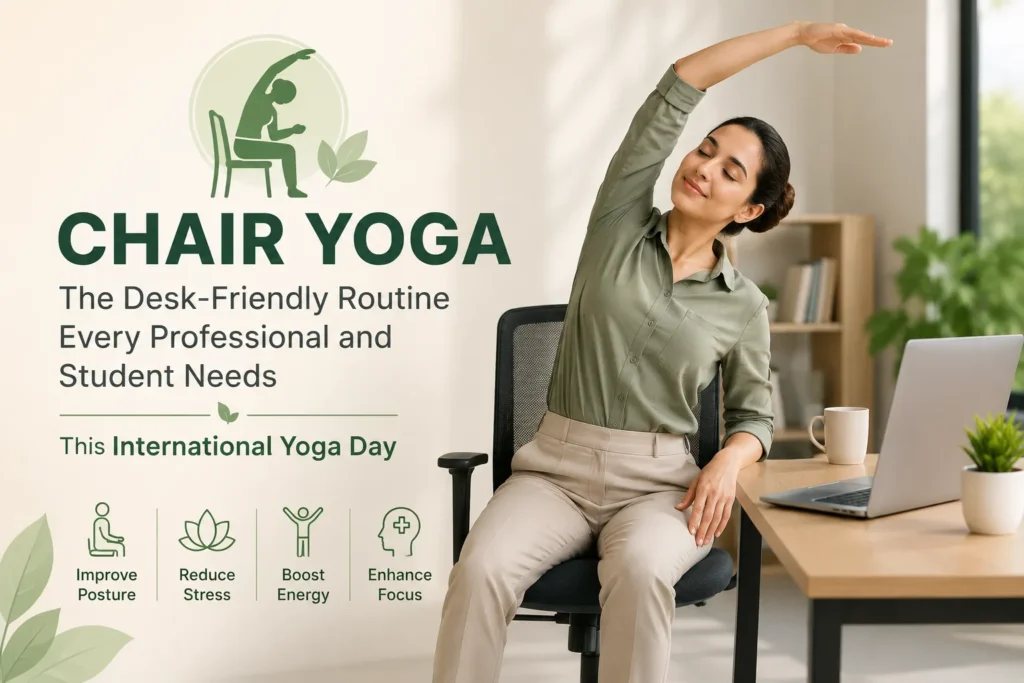
This International Yoga Day, we’re not asking you to roll out a mat or twist into a pretzel. We’re talking about chair yoga — a set of simple, science-backed stretches and eye exercises you can do without leaving your seat. Research from Johns Hopkins Medicine and Mayo Clinic both point to the same conclusion: long, unbroken sitting quietly damages circulation, posture, and focus — and small, frequent movement breaks reverse much of that damage.
In this article, you’ll learn targeted chair yoga routines for your eyes, spine, legs, and brain — built specifically for people who live at a desk, whether that desk belongs to a corporate office or a study table.
Why Desk Workers and Exam Aspirants Have the Same Problem
It’s easy to assume a software engineer and a NEET aspirant have nothing in common physically. They actually have almost identical risk factors:
- 8-10+ hours of daily sitting, often in one continuous stretch
- Close-range screen or page focus, which fatigues eye muscles
- Forward head posture, from leaning toward a monitor or textbook
- Minimal lower-body movement, leading to stiff hips and weak glutes
- Mental fatigue from sustained concentration with few real breaks
A 2025 clinical trial conducted at Kasturba Medical Hospital, Manipal, found that a short yoga asana break every hour during four hours of continuous sitting measurably improved blood vessel function compared to uninterrupted sitting. The takeaway: you don’t need an hour-long yoga class. You need consistent, small interruptions to long sitting.
This is exactly why chair yoga works — it fits into a lunch break, a study interval, or even a five-minute pause between meetings.
Chair Yoga for Tired Eyes
If you’re staring at a monitor, a coding editor, or NCERT diagrams for hours, your eye muscles are working as hard as any other muscle in your body — and they rarely get a break.
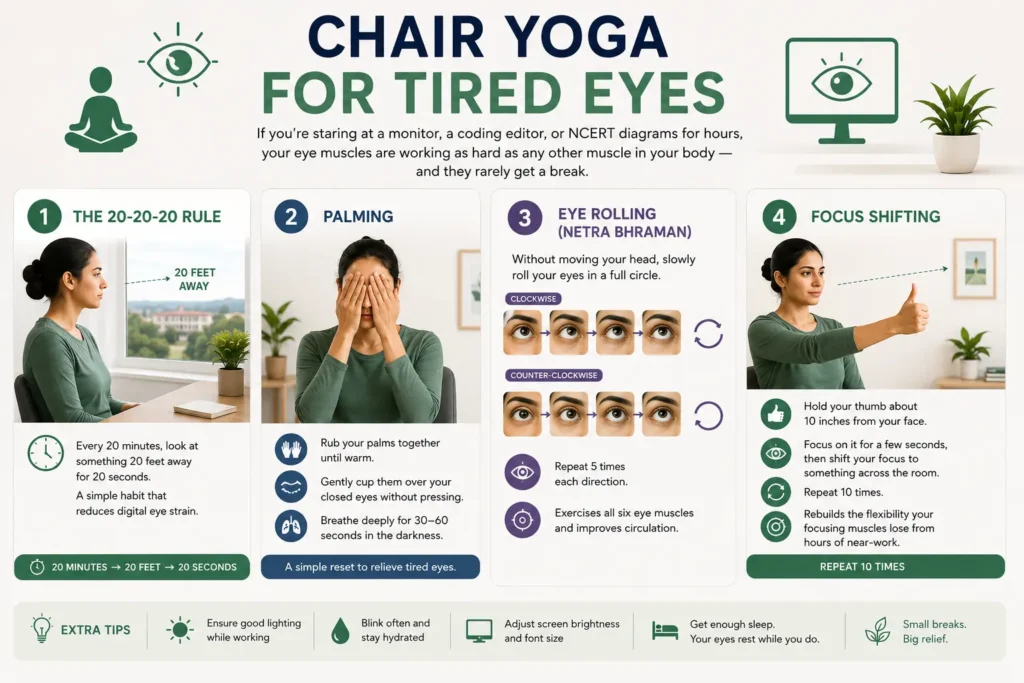
The 20-20-20 Rule
Every 20 minutes, look at something 20 feet away for 20 seconds. This single habit is one of the most effective, doctor-recommended ways to reduce digital eye strain.
Palming
Rub your palms together briskly until they feel warm, then gently cup them over your closed eyes without pressing. Breathe deeply for 30-60 seconds in the darkness. This simple reset is remarkably effective at relieving tired eyes.
Eye Rolling (Netra Bhraman)
Without moving your head, slowly roll your eyes in a full circle — clockwise, then counter-clockwise. Repeat 5 times each direction. This exercises all six eye muscles and improves circulation around the eyes.
Focus Shifting
Hold your thumb about 10 inches from your face. Focus on it for a few seconds, then shift your focus to something across the room. Repeat 10 times. This rebuilds the flexibility your focusing muscles lose from hours of near-work.
Chair Yoga for the Spine
Lower back pain is the single most common complaint among both desk professionals and long-hour students — and most of it comes from one thing: a collapsed, rounded spine held in place for hours.
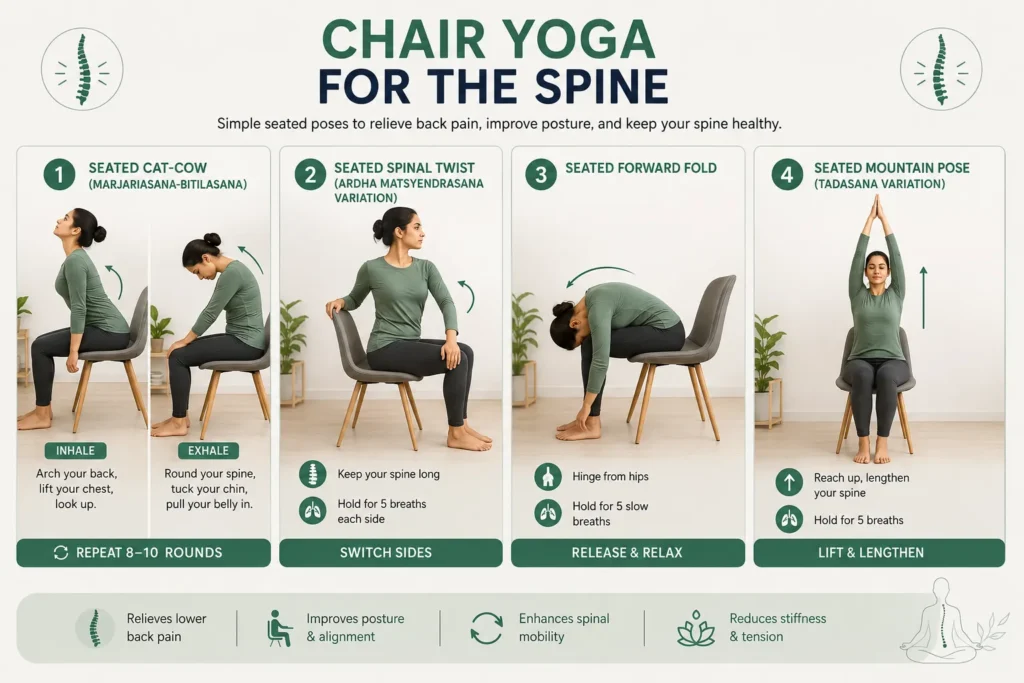
Seated Cat-Cow (Marjariasana-Bitilasana)
Sit at the edge of your chair, hands on your knees. Inhale, arch your back, lift your chest, and look slightly upward. Exhale, round your spine, tuck your chin, and pull your belly in. Repeat slowly for 8-10 rounds. This is the single best reset for a stiff spine.
Seated Spinal Twist (Ardha Matsyendrasana variation)
Sit tall, feet flat on the floor. Place your right hand on the back of the chair and your left hand on your right knee. Gently twist your torso to the right, keeping your spine long. Hold for 5 breaths, then switch sides. Twists relieve tension and improve spinal mobility.
Seated Forward Fold
Scoot to the edge of your chair, feet hip-width apart. Hinge forward from your hips, letting your chest rest toward your thighs and your head hang. Hold for 5 slow breaths. This releases the lower back and hamstrings — ideal after completing a long task or study block.
Seated Mountain Pose (Tadasana variation)
Sit tall, inhale and reach both arms overhead, palms together. Feel the lift through your entire spine. Hold for 5 breaths. A simple but powerful posture reset.
Chair Yoga for Stiff Legs
Sitting compresses your hip flexors and slows circulation to your legs — which is why your legs feel heavy or restless after long stretches at a desk.
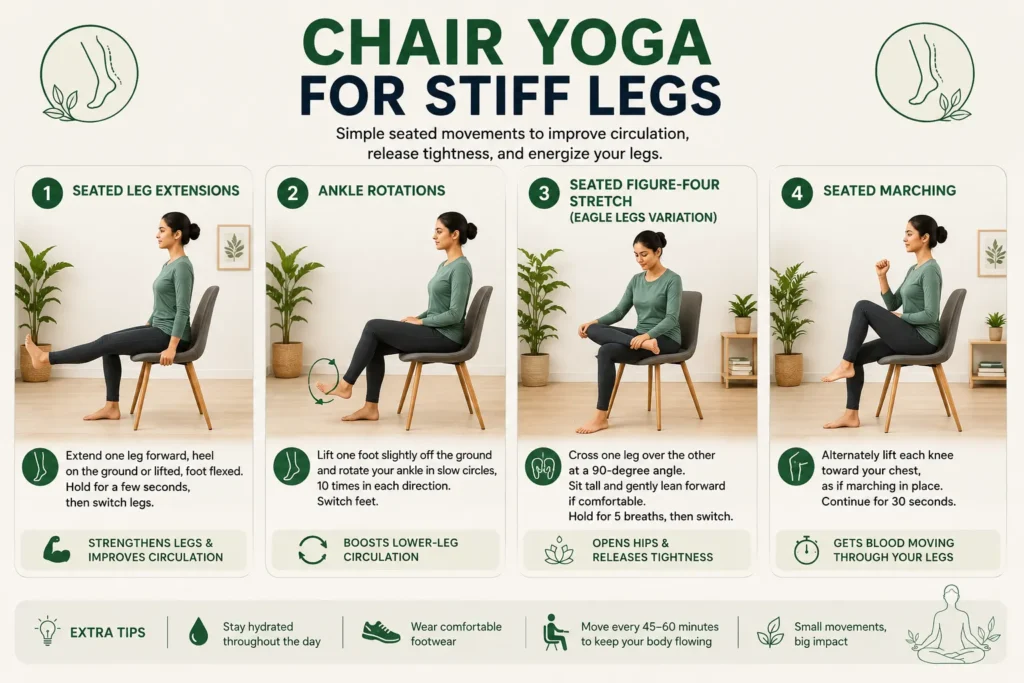
Seated Leg Extensions
Sit tall and extend your right leg forward, heel on the ground or lifted a few inches, foot flexed. Engage your thigh muscle and hold for a few seconds. Switch legs. This strengthens the legs and improves circulation that slows down during prolonged sitting.
Ankle Rotations
Lift one foot slightly off the ground and rotate your ankle in slow circles, 10 times in each direction. Switch feet. A small movement with a real impact on lower-leg circulation.
Seated Figure-Four Stretch (Eagle Legs variation)
While seated, cross one leg over the other at a 90-degree angle, resting your ankle on your opposite knee. Sit tall and gently lean forward if comfortable. Hold for 5 breaths, then switch. This opens the hips, which tighten significantly from prolonged sitting.
Seated Marching
Sit tall and alternately lift each knee toward your chest, as if marching in place. Continue for 30 seconds. This gets blood moving through the legs in a way static sitting never will.
Chair Yoga for the Brain
This is the section most professionals and students skip — but it might matter most. Mental fatigue isn’t just “in your head.” Physical stillness and shallow breathing reduce oxygen flow to the brain, directly affecting focus and recall.
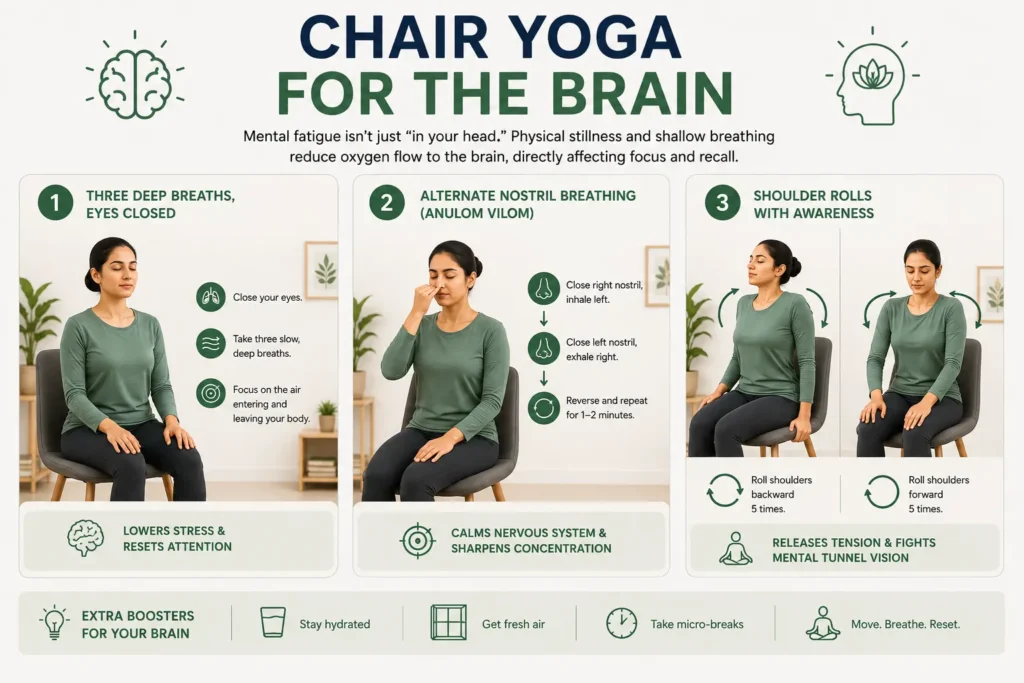
Three Deep Breaths, Eyes Closed
Sit still, hands resting on your thighs. Close your eyes. Take three slow, deep breaths, focusing only on the air entering and leaving your body. It sounds almost too simple — but this single pause is enough to lower stress and reset attention for the next study block or meeting.
Alternate Nostril Breathing (Anulom Vilom)
Close your right nostril with your thumb, inhale slowly through the left. Close the left nostril, release the right, and exhale through the right. Reverse and repeat for 1-2 minutes. This breathing technique is widely used to calm the nervous system and sharpen concentration before high-focus tasks like interviews or exams.
Shoulder Rolls with Awareness
Slowly roll your shoulders backward in large circles, 5 times, then forward, 5 times, paying attention to the sensation rather than rushing through it. This combination of movement and mindfulness interrupts the mental tunnel vision that builds during long focus sessions.
A 5-Minute Chair Yoga Routine You Can Actually Stick To
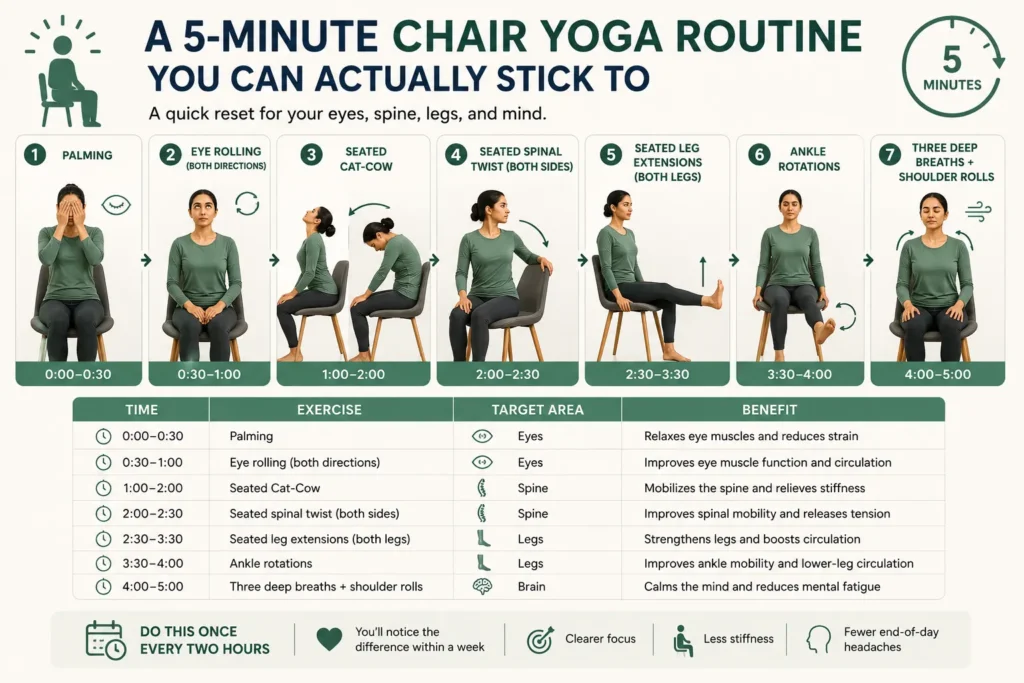
Most people don’t fail at wellness habits because the habit is wrong — they fail because it’s too long to repeat daily. Here’s a sequence designed to fit into a single short break:
| Time | Exercise | Target Area |
| 0:00–0:30 | Palming | Eyes |
| 0:30–1:00 | Eye rolling (both directions) | Eyes |
| 1:00–2:00 | Seated Cat-Cow | Spine |
| 2:00–2:30 | Seated spinal twist (both sides) | Spine |
| 2:30–3:30 | Seated leg extensions (both legs) | Legs |
| 3:30–4:00 | Ankle rotations | Legs |
| 4:00–5:00 | Three deep breaths + shoulder rolls | Brain |
Do this once every two hours and you’ll notice the difference within a week — clearer focus, less stiffness, and fewer end-of-day headaches.
FAQ
Can chair yoga really replace regular exercise?
No, and it isn’t meant to. Chair yoga is a damage-control tool for the hours you’re forced to sit — at a desk job or during exam prep. It reduces stiffness, eye strain, and mental fatigue in the moment, but it works best alongside regular physical activity outside work or study hours, not as a replacement for it.
How often should I do chair yoga during work or study hours?
Aim for a short 3-5 minute routine once every 1-2 hours. Research on prolonged sitting shows that frequency matters more than duration — several short breaks throughout the day are more effective than one long session at the end.
Will eye yoga actually reduce screen-related headaches?
For many people, yes. Eye exercises like palming, the 20-20-20 rule, and focus shifting relax the eye muscles responsible for sustained near-focus, which is a major contributor to screen-related headaches and eye strain. If headaches persist despite these habits, it’s worth getting your eyes checked by a professional.
Is chair yoga suitable for exam aspirants with very long study hours?
Yes — arguably even more useful for students than office workers, since study sessions often involve longer unbroken sitting than a typical workday. Building short chair yoga breaks into your study timetable can help sustain focus over a 10-12 hour study day without the usual afternoon mental crash.
Do I need any equipment for chair yoga?
No. All you need is a stable chair with no wheels (or locked wheels) and about 5 minutes. Every exercise in this routine can be done in office wear or casual clothing, at a desk, in a library, or in a study room.
Conclusion
Your career — and your exam results — are not built in the hours you push through exhaustion. They’re built in how well you sustain focus, day after day, without your body breaking down first. Chair yoga isn’t a wellness trend; it’s a practical tool for anyone whose daily life happens mostly in one chair, whether that’s a corporate desk or a study table.
This International Yoga Day, don’t aim for a perfect, hour-long practice. Aim for five honest minutes, repeated through your day — for your eyes, your spine, your legs, and your mind.
At HTS India, we don’t just train you for a corporate career — we care about how you sustain it. To every professional building their future at a desk, and every student preparing for the exam that gets them there: take care of the body that’s carrying you through it.
Happy International Yoga Day, from all of us at HTS India.