
You have done some research. You have shortlisted two paths. And now you are stuck – because both look good on paper, and no one is giving you a straight answer.
This guide will.
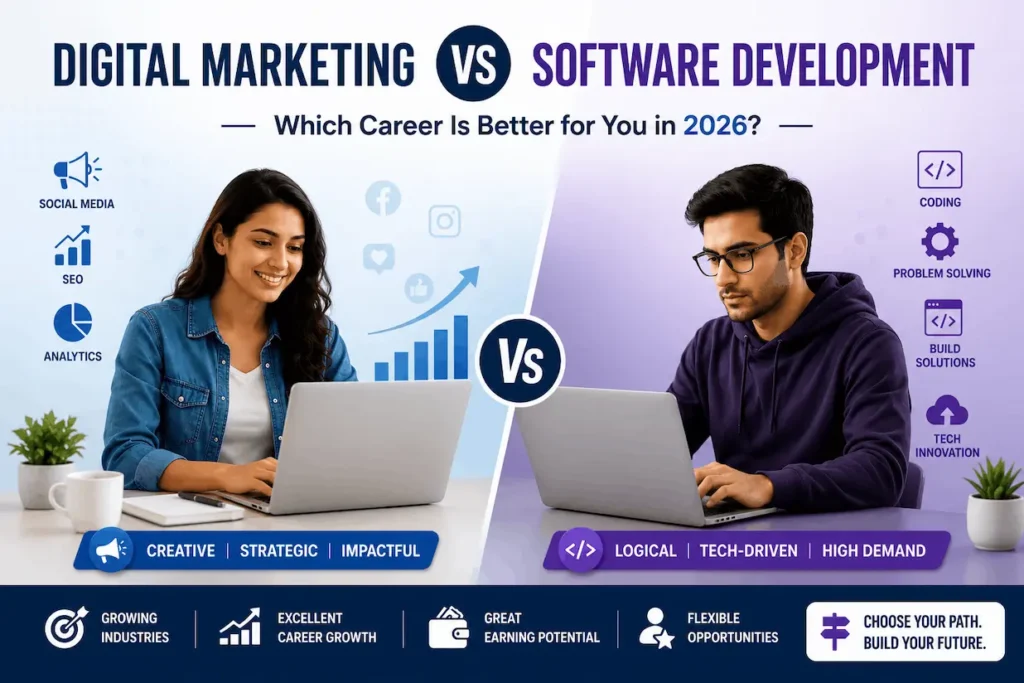
Digital Marketing and Software Development are two of the most in-demand career tracks coming out of IT training in 2026. Both pay well. Both have strong job markets in Delhi NCR. But they suit very different kinds of people – and they get you to your first ₹10 LPA at very different speeds.
By the end of this guide, you will know exactly which path fits your personality, your timeline, and your goals.
What Does a Typical Day Actually Look Like?
Most career guides describe these roles in vague, aspirational terms. Here is what a real workday looks like in each.
A Day in the Life of a Digital Marketer
8:30 AM – You open Google Analytics and your Meta Ads dashboard. You check if yesterday’s campaign hit its cost-per-click target. It did not. You note that the ad targeting a 25–34 age group underperformed and flag it for revision.
10:00 AM – You are in a content planning meeting. The team is mapping out next month’s SEO blog calendar. You pitch three article ideas based on keyword research you did in Ahrefs the previous evening.
12:00 PM – You write copy for a new Google Search ad set. You write five headline variants, test them mentally against the target audience, and pick three to A/B test.
2:00 PM – You pull a performance report for a client. Organic traffic is up 18% month-on-month. You build a slide deck showing which keywords moved and why.
4:30 PM – You review a competitor’s email campaign that landed in your inbox. You screenshot three things they did well and one structural mistake. You add it to your swipe file.
No two days are identical. The work is fast-moving, often collaborative, and always tied to numbers – clicks, conversions, rankings, revenue.
A Day in the Life of a Software Developer
9:00 AM – You open your task board. Three tickets are assigned to you: fix a login bug reported by QA, add a filter feature to a product listing page, and review a pull request from a junior developer.
10:00 AM – You spend ninety minutes on the login bug. You trace the error through the codebase, identify a broken session token, fix it, write a test, and push the commit.
12:00 PM – Lunch. You skim a technical article on a new React hook you have been meaning to try.
1:30 PM – You start building the product filter feature. You write the backend logic first in Python, then connect it to the frontend. This takes most of your afternoon.
4:30 PM – You review your junior colleague’s pull request. You leave three code comments – two about naming conventions, one about a potential performance issue – and approve it.
5:30 PM – You close your laptop. The filter feature is 60% done. You pick it up tomorrow.
The work requires deep focus, logical problem-solving, and patience. You work mostly independently, but code reviews and standups keep you connected to the team.
Salary Comparison: What You Can Actually Earn
Figures below are based on aggregated industry data for Delhi NCR.
Digital Marketing Salaries
| Experience Level | Average Annual Salary (Delhi NCR) |
| Fresher (0–1 year) | ₹2.5–4.5 LPA |
| Mid-level (2–4 years) | ₹6–12 LPA |
| Senior / Manager (5+ years) | ₹14–25 LPA |
| Head of Marketing / VP | ₹30 LPA+ |
Specialist roles that pay more: Performance Marketing Manager, SEO Lead, Marketing Automation Specialist, and Growth Hacker roles at startups can reach ₹15–20 LPA at 4–5 years of experience.
Software Development Salaries
Figures below are based on aggregated industry data for Delhi NCR.
| Experience Level | Average Annual Salary (Delhi NCR) |
| Fresher (0–1 year) | ₹3.5–7 LPA |
| Mid-level (2–4 years) | ₹10–20 LPA |
| Senior Developer (5+ years) | ₹22–40 LPA |
| Lead / Architect | ₹50 LPA+ |
Specialist roles that pay more: Full Stack Developers, DevOps Engineers, and ML Engineers command premium salaries at every level. Remote global roles – available to strong Indian developers – can reach $80,000–$120,000 USD annually.
The honest comparison: Software Development starts higher and scales faster, especially if you go into Full Stack or backend roles. Digital Marketing has a slower early curve but offers strong ceiling if you move into leadership or freelance consulting.
Which Career Suits Your Personality?
This is the question most people skip – and it is the one that matters most.
You are probably a better fit for Digital Marketing if:
- You enjoy writing, storytelling, or visual communication
- You get a buzz from seeing campaign numbers move
- You like working with multiple people, tools, and platforms simultaneously
- You enjoy understanding what makes people click, buy, or share
- You prefer variety over depth in your daily work
- You have ever spent time on social media thinking “I could run this brand better”
Strengths it rewards: creativity, communication, curiosity, pattern recognition, persuasion.
You are probably a better fit for Software Development if:
- You enjoy solving logical puzzles – and feel genuine satisfaction when something broken starts working
- You can sit with a problem for hours without getting restless
- You prefer to build things rather than promote them
- You like working independently for long stretches
- You have ever looked at a website or app and thought “I want to know how this works”
- You do not mind ambiguity, as long as there is a clear right answer at the end
Strengths it rewards: logical thinking, attention to detail, persistence, systematic problem-solving.
If you sit in the middle
Many people do. If you are creative but enjoy structure – or analytical but want to express ideas – you may be better suited to roles that combine both. We cover those next.
Job Security and Future Automation Risk
AI is changing both fields. But it is changing them very differently.
Digital Marketing and Automation
AI tools like ChatGPT, Jasper, and automated ad bidding systems are already handling parts of a digital marketer’s job – basic copywriting, bid optimisation, email personalisation at scale.
What this means for you: Junior roles that involve repetitive content or mechanical reporting are at the highest risk. Roles that require strategic thinking, campaign interpretation, brand judgment, and creative direction are not going anywhere.
The digital marketers who will thrive in 2026 and beyond are those who understand how to use AI tools – not those who compete with them. A marketer who can prompt, evaluate, and refine AI-generated content is far more valuable than one who writes slowly by hand or one who blindly publishes whatever AI produces.
Risk level for entry roles: Medium. Risk level for strategic roles: Low.
Software Development and Automation
AI coding tools – GitHub Copilot, Cursor, Claude, ChatGPT – are genuinely changing how developers work. They write boilerplate, suggest fixes, generate test cases, and explain code.
What this means for you: These tools make developers faster, not obsolete. A developer who uses AI effectively can do in three hours what used to take a day. That is a productivity gain – and companies respond to that by hiring developers who can use these tools, not by eliminating development roles.
The most resilient developers are those who understand system architecture, can debug complex problems, and know how to review and correct AI-generated code. Those skills require deep technical understanding – something no prompt can replace yet.
Risk level for junior developers: Low to medium (code generation handles some basics). Risk level for experienced developers: Very low.
Bottom line: Both fields are being transformed by AI. In both cases, the answer is the same – learn how to use the tools, not just the underlying discipline.
Can You Combine Both? (Yes – and It Pays Well)
Some of the most in-demand and highest-paid roles in 2026 sit at the intersection of marketing and technology.
Growth Hacker
A growth hacker combines marketing strategy with technical skills – they can run A/B tests, read analytics data, build basic automation, and understand the product deeply enough to identify growth opportunities. Companies like Swiggy, Razorpay, and Meesho built their early user bases through growth hacking.
Typical salary: ₹10–20 LPA at 3–5 years of experience.
Marketing Technologist
A marketing technologist manages the technical stack that a marketing team runs on – CRM platforms, marketing automation tools, data pipelines, attribution models. They speak both languages: marketing and engineering.
Typical salary: ₹15–28 LPA at mid-to-senior level.
SEO + Python Developer
A developer who understands SEO can automate technical audits, build custom crawlers, and analyse keyword data at scale. This combination is rare and extremely valued at SEO agencies and large e-commerce companies.
Web Designer + Digital Marketer
Someone who understands both UI/UX design and conversion optimisation can build landing pages that both look good and convert visitors into customers. This is a critical skill gap most companies are actively trying to fill.
If you want to cover both paths, consider starting with HTS India’s Web Designing course alongside a Digital Marketing course, or pairing Python training with performance marketing skills.
Which Path Gets You to ₹10 LPA Faster in Delhi NCR?
This is the question most students are really asking.
Here is an honest, direct answer.
Software Development: Faster to ₹10 LPA
If your goal is to cross ₹10 LPA as quickly as possible, Software Development – specifically Full Stack Development – gives you the faster path.
A Full Stack Developer with 1.5–2 years of solid experience and a strong project portfolio is regularly hitting ₹10–14 LPA in Delhi NCR. The starting salaries are higher, the jump from fresher to mid-level is faster, and the skills are immediately transferable across industries.
HTS India’s Full Stack course is built for exactly this outcome – taking you from fundamentals to full-stack project work with placement support.
Typical timeline to ₹10 LPA: 18–24 months from starting to learn
Digital Marketing: A Slightly Longer Path, But Different Ceiling
A Digital Marketing professional typically reaches ₹10 LPA at the 3–4 year mark, not 1.5–2 years. Starting salaries are lower, and the jump to senior pay requires demonstrated results – campaign data, traffic growth, conversion improvements – not just skill certificates.
However, Digital Marketing offers something Software Development does not at the junior level: it is easier to freelance early. A digital marketer with 6 months of solid skills can start taking small clients and building income outside a salaried role. Many Delhi NCR professionals combine a part-time job with freelancing and hit ₹8–10 LPA equivalent within two years through combined income.
HTS India’s Digital Marketing course covers both the strategic and tool-level skills you need to freelance or get placed.
Typical timeline to ₹10 LPA (salary): 3–4 years Typical timeline to ₹10 LPA (combined salary + freelance): 2–3 years
The Honest Summary
| Factor | Digital Marketing | Software Development |
| Starting salary (fresher) | ₹2.5–4.5 LPA | ₹3.5–7 LPA |
| Time to ₹10 LPA | 3–4 years | 1.5–2 years |
| Freelance potential (early) | High | Medium |
| Creative work | High | Low–Medium |
| Logical / technical work | Medium | Very High |
| Remote/global opportunities | Medium | Very High |
| AI automation risk | Medium | Low–Medium |
| Suits personality type | Creative, communicative | Logical, detail-oriented |
So – Which One Is Right for You?
There is no universally correct answer. But there is a right answer for you.
Choose Digital Marketing if: You are drawn to creativity, communication, and building brands. You want to freelance early. You enjoy seeing the impact of your work in real-time through data that non-technical people can also understand. Here is the complete guide of digital marketing course.
Choose Software Development if: You enjoy logic and problem-solving. You want the highest starting salary and fastest path to ₹10 LPA. You are comfortable with deep, focused work and want long-term optionality – including global remote roles.
Choose both (strategically) if: You are genuinely curious about how technology and marketing intersect. Roles like Growth Hacker and Marketing Technologist are high-paying, undersupplied, and growing fast. Starting with one and adding skills from the other over 2–3 years is a legitimate career strategy.
Whatever you choose, the path starts the same way: with structured, hands-on training that builds real skills – not just certificates.
Start with the Right Course
HTS India has trained 65,000+ students since 2000. Courses run at the Kalkaji centre with weekday and weekend batch options.
- Explore Digital Marketing Course – for those who want to build brands, run campaigns, and grow businesses online
- Explore Python Course – the foundation for data, automation, and backend development
- Explore Web Designing Course – for those who want to build beautiful, functional websites
- Explore Full Stack Development Course – for the fastest path to a high-paying developer role


